DOBA
Sensation Dom
“Rope, hands, the exact pressure — I place you where I want you.”
What Is DOBA?
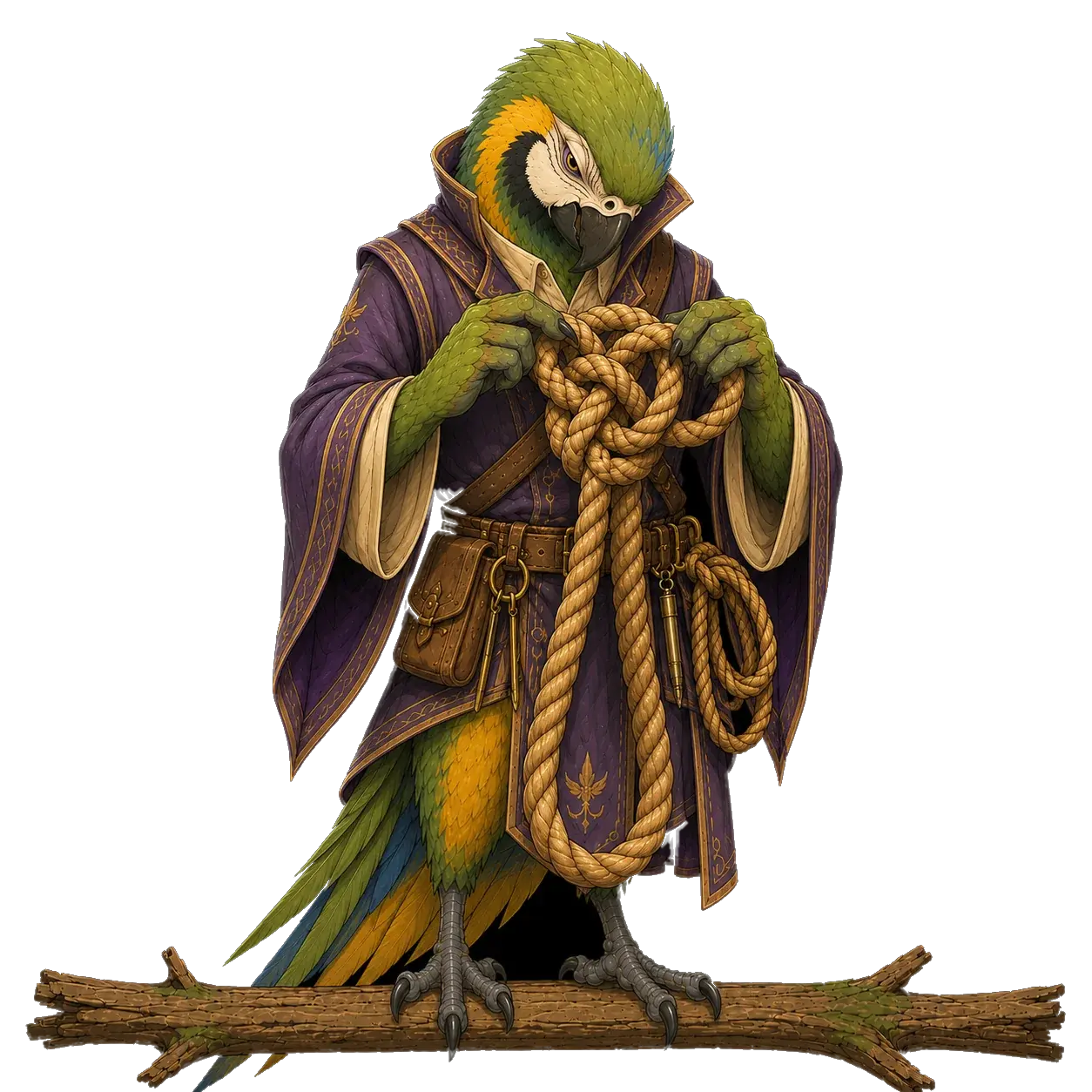
DOBA (Sensation Dom) is one of the types in the 16Kinks system, made up of four dimensions: Dominant, Outer, Body, Attune. You belong to the scene Dom (DO) family — your power is at its most focused, most refined, inside the scene. Your arousal mode is envelopment (BA) — you build immersion through bodily wrapping and frequency-tuning. DOBA's core trait: you speak with your hands, you take charge through texture, and the path every rope takes is never an accident.
Of all the Dom types, DOBA might be the closest to a 'craftsman.' You don't lean on wordplay, you don't lean on psychological pressure, you don't lean on shows of power. The second the scene begins, your hands are already on your partner reading the signals — the temperature of their skin, the tension or slack in their muscles, the depth of their breath. Going into a scene with you, what your partner feels isn't being dominated — it's being wrapped, layer by layer, by a pair of hands that miss nothing. Like water rising slowly over the body — warm, precise, no escape.
Hands Are the Language
DOBA's most defining trait is your hands.
Other Doms might build a scene through voice, through presence, through rules. You don't work that way. Your entire expressive system is built on touch — the run of the rope, the shift of texture on skin, the transition between two positions, the brief pause before a knot pulls tight. In your hands, these aren't procedural steps — they're a language with temperature and rhythm.
The way you pick up rope already tells your partner a lot. You don't rush to start — you run the rope through your hands first, feeling its thickness, its softness, how it sits today. Then your hand finds skin, and the first contact point is already carrying a message: I'm here. I'm clear. I know what I'm doing.
This is the biggest thing that separates you from other Doms: your calibration isn't about being cool-headed — it's attention pulled to its sharpest point, focused so tight that every centimeter of rope path, every degree of pressure shift, carries meaning.
The Process Is the Piece
As a Body + Attune type, your channel of expression is bodily and immersive.
What you care about isn't just the final result — given the same restraints, the texture of what you tie is completely different from what someone else ties. The difference isn't in how tight the rope is or how hard the position is — it's in the 'feel' of the whole process: the speed of the rope sliding across skin, the pause at every turn, whether the pressure builds gradually or arrives all at once the moment the rope pulls tight. Every single detail is a choice you're making.
What you enjoy most isn't the moment a piece is finished — it's every judgment call along the way: tighten here or loosen, push the pressure up a notch or back it off, when to let your partner think it's over and then add another layer. You're making real-time micro-adjustments through touch — a tremor from your partner, a sharp intake of breath, the slight pull-back of a shoulder, all of it gets read instantly, and the next move adjusts itself.
What you're doing isn't 'doing something to a body' — you're using your hands to build a space someone can sink into. The finished piece is just a by-product. The real work is the process itself.
You Live in the Scene, Not the Relationship
You belong to the scene-type Dom (Outer) family, and that one fact decides everything that separates you fundamentally from the relational Dom (Inner) types.
A relational Dom's authority runs in daily life — the rules, the forms of address, the ongoing frame. But your power is scene-shaped: inside a scene you're the most precise craftsman; once the scene ends, you might be a quiet person, maybe even a little awkward with words. This isn't fake — it's that your attention really is at its most focused, its sharpest, inside the scene.
This means your kink has clear edges. 'Starting now' and 'ending now' are obvious to you. Once it starts, every detail gets the whole of you; once it's over, you step out of craftsman mode. For some partners this clarity is reassuring — they know when they're in play and when they're not. For other partners, you might feel almost like a different person outside the scene.
For you, the scene is your workbench. You don't need a 24/7 power structure — what you need is that instant the rope lands in your hand, attention focusing like a laser, and then every movement is alive.
Not Just 'Good With Your Hands'
Put the four letters together: DOBA stands on the Dom side (D), is at full power inside a scene (O), speaks through the body (B), and pulls a partner under through wrapping and attunement (A). All four dimensions point at one thing: not a technician operating with precision — someone who builds a world out of texture inside the scene, every single move carrying real investment.
Common Misreads
“DOBA Is Just Good at Rope / Pure Craftsperson”
This is the most common misread. Your craft really is good — but if all someone sees is the craft, they've missed the most important part. There's real investment in every single move you make: not just technical accuracy, but 'I'm talking to you with this rope.' A rigger chasing pure technique cares whether the tie is correct; you care whether the way this rope feels on their body is correct. That's the difference between craft and expression.
“DOBA Doesn't Care About Headspace / Body Only”
You don't really use words to prep the headspace — but that doesn't mean you don't care. Your hands ARE your headspace prep. The first second the rope lands on their skin is already saying 'you can let go,' the rhythm of the tightening is saying 'I know where your limit is,' the few seconds at the end when your hand stays on them are saying 'I'm still here.' These things just aren't being said out loud.
“DOBA Can Play With Anyone”
Because your point of entry is physical and technical, it can look like you don't need any deep connection to start. But your Attune mode means you need a real bodily response from the partner — not playing along, not enduring, an actual answer back. A partner who isn't giving feedback or who's faking it — you can feel it the second your hands go on. Your precision is built on the partner's realness.
What You Really Want
Your desire lives in your fingertips. Rope, tactile feel, the texture of skin, a perfect transition — every single move is a real-time calibration against the partner's body frequency. Technical execution coming out perfect is just a byproduct; what actually gets you high is the tuning itself.
But that's just the surface. What you're truly hooked on is an extraordinarily specific state: the warmth is traveling through the rope, the skin under it is answering back, and a closed loop forms between the two of you — no words needed, touch itself doing all the talking.
The rope leaves your hand, winds up, rounds a joint, draws tight. Their breath goes deeper — not from pain, but because the tightening landed exactly on the pressure that pulls a person under. Your hand reads that shift, the next wrap automatically slowing a little, giving them time to stay with the feeling. Then one step further. One more step. Layer by layer, sinking down.
That process — the rope reading, the skin answering, the rhythm of breath surfacing on its own between the two of you — is what you're really chasing. Not the tie itself, but the immersive space built out of touch.
Immersion in Texture
The moment you most savor in a scene isn't the finished piece at the end — it's the instant, mid-process, when some texture hits perfect.
The rope passes along the side of the ribs — the speed exact, the pressure exact — and goosebumps rise across their skin. The second a position lands exactly right, their breath drops deep and slow — and they sink all the way in. Your palm slides from shoulder to the side of the waist, every inch of skin it crosses speaking. These moments aren't planned — they grow on their own out of the live conversation between your hand and their response.
That perfection of texture is your deepest layer of desire: not just having done one thing correctly — it's two bodies finding a shared frequency inside touch. At that frequency, every sense becomes the most sensitive receiver — the depth of their breath, the slack or tension of their muscles, the smallest temperature shifts on their skin, all amplified. Every choice instinctively known to be the right one. The whole world narrowed down to rope, skin, breath.
Craft That Gets Seen
At the deepest layer of your desire, there's a very private longing: someone who doesn't just enjoy the final effect — someone who sees every single choice inside the process.
Most of the time, the investment you put into the details goes unseen. The partner might think 'the tie felt nice,' 'good technique' — but why that rope ran this line and not that one, why the pressure tightened in this exact second rather than the one before, why the transition between two positions took exactly this speed — the investment inside all those choices usually gets brushed off as 'good at technique.'
But if there's someone — who closes their eyes when the rope crosses their skin, not because they're enduring it but because they're feeling every centimeter of the change. Someone who, at the instant of a transition, draws a small breath in — not from pain, but from being struck precisely by the exactness of your rhythm. Someone who then lifts their face to look at you, the look in their eyes saying 'I know what you just did' — in that instant, what you feel isn't just being acknowledged. It's being seen, fully. Your hands aren't just tools — they're the extension of a person with warmth, with an aesthetic, with something to say. That feeling of being seen is more precious than any praise.
Hidden Need
You want someone to truly appreciate the care you put into the details — not just see you as someone who's good at the craft.
Your biggest fear is being treated as a service provider — 'you tie so well, I'll book you again' — because there's real investment in every move you make, and you don't want to be reduced to 'good at technique.'
You wish someone could care for you while you're caring for them — because that density of attention you're putting out is extraordinarily depleting, and very few people stop to think that you also need to be caught.
Your most hidden longing: someone who can tell how much care and expression live inside your 'precision' — instead of only seeing a technician whose execution is on point.
Flavor Tags
In Scene
How You Build the Scene
Your scenes start in a distinctive way: not through announcement, not through presence — through the first touch of the hand.
The way you drop in might look like this: the rope passes through your hands once, your fingers reading the state of the fiber today. Then you walk up to your partner, your palm settles lightly on their shoulder — and that pressure is already speaking. Not heavy, not light — exactly calibrated to pull their attention in. Their muscles tense for a beat and then release — you read the signal, and you know you can begin.
The first wrap of rope is slow. Not because the technique needs it to be slow — because you're using the first wrap to read the whole person: how tense their body is today, how sensitive their skin is, whether the breath is shallow or deep. All of that information starts coming in the first second the rope touches the skin.
Then the rhythm builds. The speed of each wrap, the pressure, the direction — none of it is preset. All of it adjusts in real time to your partner's body. Your scenes don't follow a plan — they're the result of an ongoing conversation between hand and skin.
The Moment Hand and Body Fully Sync
Your highest moment is a very quiet one — so quiet that from the outside, almost nothing looks like it's happening.
The rope has reached a certain placement; the last cinch is complete. Your partner's breath shifts from fast to slow — not the slowness of giving up, the slowness of dropping in. Their shoulders come down, their chin tips slightly forward, the whole weight of them is handed over to the rope. Your hand rests on the rope, feeling the vibration coming back from their body — heartbeat, breath, the tiny micro-shifts as the muscles slowly settle inside the binding.
In that instant, you know: this person has dropped all the way in. Not because they're tied too tight to leave — because they've been caught by the space your rope built out of temperature, pressure, and routing, and they're choosing, completely, to stay there.
That state — your partner's body trusting enough to hand over its full weight, while your hands know exactly the tension of every rope and the state of every load-bearing point — is what you're chasing inside a scene. It's not the tie itself. It's that feeling of two people becoming one system through the rope.
What Pulls You Out Instantly
Three things will switch you off instantly:
Performed reactions. Your entire system is built on reading real bodily feedback — if your partner is putting on a show (over-the-top sounds, deliberate compliance, holding back the wince when something actually hurts), your hands immediately feel the signal is off. You may not be able to say exactly what's wrong, but the hands know. The moment the feedback stops being trustworthy, the tuning breaks.
Being rushed. Your process IS the piece — if your partner keeps sending signals like "hurry up" or "that's enough," you feel yourself being treated like someone executing a task. You're not completing an operation; you're building a space. Rushing demotes "building" to "operating."
The one-way consumer posture. If your partner lies down, closes their eyes, and waits to "be tied" — no bodily participation, no response — you feel a very deep loneliness. What you're building is a space between two people, not a one-sided performance. The moment your partner puts themselves in the audience seat, your investment has nowhere to land.
Aftercare
Your aftercare is the easiest part of a scene for people to overlook — but for you, it's part of the process, not an add-on.
The untying process is itself the start of aftercare. You don't strip the rope off all at once — you release it wrap by wrap, and as each section comes off, your hand pauses on the skin that was just under rope. That pause isn't checking (though it is also checking) — it's your hand telling them: I'm still here, I see it, your body is being looked after.
After all the rope is off, you might go quiet. Not because you don't care — because the attention you were just outputting was extraordinarily dense, and coming down from that high-precision focus takes time. Your hand might stay on their body, not doing anything, just resting there. That weight — not gripping, not pressing, just laid lightly down — is you using your body to say "I'm still here."
But you need aftercare too — this part gets overlooked all the time. The attention you put in is no less than the physical sensation your partner takes on. If your partner can give you a signal in this moment — a movement that leans in, a quiet "what you did was beautiful" — you feel yourself as more than a pair of hands. You feel yourself as someone who's been seen.
Kink Tags
DOBA and Their Partner
The Person Behind the Hands
Inside a scene, a DOBA is a pair of extraordinarily precise hands — but behind those hands is a whole person.
A lot of partners walk away from their first scene with a DOBA carrying a strange feeling: well taken care of, fully immersed, the whole process like being wrapped inside a safe space — but somehow not quite knowing the person who just did all of that. Their tactile expression is so fluent that you sometimes only register the immersive experience, and don't see the person behind it who was pouring in all of their attention.
Nothing they do is casual. How the rope runs, how much pressure, where it stops — every bit of it is their judgment and their investment. When you compliment them on "good technique," what they hear may be "you only saw my hands." But when you say "that adjustment just now made me feel like you really cared about me" — what they hear is "you saw me."
Because most people stay inside the rope's temperature and rhythm — and very few look up to see what's in the eyes of the person making it all happen.
A Few Things You Need to Know
Being with a DOBA, there are a few things worth knowing as early as possible:
Speak up the moment something doesn't feel right. DOBA's precision is built on your real-time feedback. Their hands are constantly reading your body, but what their hands pick up isn't necessarily more accurate than what you yourself are feeling. If you don't say anything, what they read might be "still okay" when the truth is "actually past okay." Your honesty isn't interrupting them — it's helping them do this better.
Try to notice the process they're working through, not just the end sensation. What DOBA makes with the body is their language. If you can, while you're being taken care of, also feel the path of the rope, the shifts in pressure, the deliberately designed pauses — you've stepped into the space DOBA actually wants to share with you.
They may not be great at expressing feelings out loud. But every piece of care their hands give your body is them saying they care about you. The two seconds the rope lingers on your shoulder, the light brush of their fingers over the skin a tie just left, as they untie you — these are DOBA's love letters.
They need care too. The attention DOBA puts out during a scene is extremely depleting. After play ends, they may be very quiet, very empty. This isn't the moment to press them with "what's wrong" — lean in, touch them, tell them "what you made felt so safe to be inside." They need to know the investment they handed over got received.
How They Show Up in the Relationship
DOBA is scene-type, which means their kink energy is most concentrated inside a scene. In everyday life, DOBA may look a little different from the person they are in play — not as sharp, not as precise, even a little unsure how to express themselves.
This isn't a split self — it's because DOBA's expression channel is tactile, scene-based, high-precision. Asking them to carry the density of play into ordinary conversation is like asking a sculptor to explain the path of their fingers in words — doable, but something always feels missing.
In a relationship, what DOBA needs isn't a 24/7 power structure — it's regular, quality scenes. That's their way of expressing themselves, and their way of recharging. If the scene frequency drops too low, or scenes start turning into mechanical repetition, DOBA begins to feel stifled — they may not be able to put their finger on why, just a sense that their hands haven't spoken in a long time.
The best thing a partner can do is give DOBA small body signals in everyday life: don't look at your phone while they're rubbing your shoulders, lean in a little when they're straightening your clothes, occasionally put your hand out toward them and say "help me put some hand cream on" — those moments where DOBA's hands get to speak in everyday life too are how you keep the connection alive.
How a DOBA Loves Someone
A DOBA's love looks like a pair of hands — quiet, precise, hands that always know where to land.
They may not write love letters, may not say sweet things, may not find the right words in the middle of an argument. But in play, they'll tell you "I care about you" through the path of every rope — why that rope goes around this joint instead of straight across, because you mentioned last time it felt a little sore there; why the pressure goes lighter right here, because their hand felt your muscle tighten a second ago. That kind of precision isn't technique — it's the resolution of love.
Outside of scene, a DOBA's love is quieter. They aren't good at unprompted emotional expression, but they'll take care of you with their body — rub a shoulder that's gone stiff, tuck your hair behind your ear at the dinner table, keep their hand at your waist while you walk. The way they care is the way they play: precise, somatic, no extra words.
The most particular way a DOBA expresses love is in the time they spend on your body. A DOBA will spend forty minutes slowly wrapping you into a single rope arrangement — and every second of those forty minutes is saying "you're worth being treated like this." It's not a question of efficiency — it's that they're choosing to give their most concentrated attention, their most precise touch, all of it to you. That density of giving lands heavier than any line of sweet talk.
After the Trust Is Built
DOBA may start out with a deliberate kind of perfectionism — every step has to land just right, every detail has to be precise. Not because they aren't relaxed, but because they aren't sure whether the other person can catch the moments that haven't been perfectly wrapped.
Once the trust is built, DOBA starts to release — not by getting flashier, but by getting more real. The motion of the hand isn't as careful anymore; occasionally there's an unplanned pause — not a mistake, just a moment where they wanted to feel the temperature of your skin a little longer. The path of the rope may stop being textbook-pretty and start carrying the marks of a real-time conversation happening between the two of you.
A DOBA who fully trusts their partner will, every once in a while, show a vulnerability you don't expect. There might be a moment after a scene where they don't quietly start undoing the rope — instead they bury their face in your shoulder and let out one long breath. In that moment, DOBA isn't the craftsman anymore — they're a person setting down all of their precision and all of their restraint. If you can catch that moment — without commenting, without making a big deal of it, just keeping your hand on their back — you've met the person behind those precise hands, willing to set down everything they've been holding back.
Send to Your Partner
“There's a pattern about me you may have already noticed: in play I get extremely focused on the texture and the details. How the rope runs, how much pressure, where to pause — these aren't operational steps to me, they're me having a conversation with your body.
Every adjustment I make has my judgment and my investment behind it. If something doesn't feel right, just say it — my precision is built on the feedback you give me; speaking up isn't interrupting me, it's helping me.
One more thing: I know I'm not great at expressing feelings out loud. But every piece of care my hands give your body is real — the extra second a rope lingers, the brush of fingers across your skin while I'm untying you — these are how I say I care about you. If you can sometimes tell me you felt those — that matters more to me than any compliment.”
How to Bring It Up
One-liner:
“On the kink side I lean toward the sensation-and-touch type — rope, texture, rhythm; I like building the experience through touch.”
On a date:
“I took a kink-type test and came out as a Sensation Dom — the kind whose interaction style runs through touch, attentive to texture and process. It might sound a little niche, but for me this is an extremely careful way of expressing myself through the body. If you're curious, you can take a look at the framework.”
With a long-term partner:
“I know in play I'm almost like a different person from the everyday me — the me inside a scene is extremely precise and focused; in ordinary life, I'm actually not so good at expressing myself. That version of me who does everything with my hands isn't a performance — it might be the way I can articulate myself most clearly. I'm working on letting you feel that same investment in everyday life too.”
Compatibility
Type isn't a matching algorithm. It won't tell you "who you should be with" or "who you can't make it work with."
People are complex — far more complex than four letters. And people change — your pattern today doesn't mean you'll always be this way, and the same goes for your partner.
What the analysis below is actually trying to help you do: see clearly what tends to happen between you and different types, understand where those "why are we stuck on this again" moments actually come from, and know which direction to work in to make the relationship better. It's a mirror, not a verdict.
Best Match
SOBASensation SubSOBA and DOBA are mirror types: the last three letters are completely identical (O-B-A) — only the power position is reversed.
This means the two of you speak the same body language. The moment DOBA's hand lands on skin, SOBA's body gives back the truest response there is — that loop closes on the first contact. What SOBA enjoys is exactly what DOBA is best at giving: fine-grained texture, the slow immersive build, the safety of being wrapped layer by layer. What DOBA needs is exactly what SOBA is best at offering: someone who responds honestly to every inch of touch — someone who doesn't perform, doesn't grit through it, every reaction growing out of their body.
The picture this pairing makes is extraordinarily vivid: in scene, the two of you are like hand and skin — one giving precisely, one responding honestly. The goosebumps rising on SOBA's body when a rope crosses their ribs are the best answer there is. DOBA's particular loneliness — "I put my whole attention into this and they only complimented the craft" — simply doesn't happen with SOBA, because SOBA reads DOBA's care in every detail of the touch.
Where's the risk? The two of you may get so comfortable inside the tactile world that you stop wanting to use language to handle the deeper relational questions. Both of you are Outer types — everyday connection and verbal-level communication may become something both of you have to deliberately practice.
Most Sparks
SIBEClaimed SubSIBE and DOBA share complement on the first position (D↔S) and identity on the third (B=B), but differ on the second and fourth: DOBA is Outer (scene-type), Attune (calibrating); SIBE is Inner (relational), Edge (pushing).
This pairing carries a very particular kind of tension. In scene, the two of you are aligned on the body channel — DOBA's tactile precision and SIBE's hunger to be claimed are running on the same road. The moment DOBA wraps SIBE into the rope, what SIBE feels isn't just bondage — it's belonging. The spark is immediate.
But what SIBE wants isn't only one beautifully built scene — they want to bring that "held by your hand" feeling into everyday life, into every day of the relationship. DOBA's precision is most concentrated inside the scene; in everyday life it may go quiet enough to leave SIBE uneasy: "In scene you took such fine care of my body — why does it feel like you're barely there in everyday life?"
At the same time, SIBE's Edge lean means they sometimes want to be pushed toward a sharper edge — and DOBA's Attune mode leans toward wrapping and immersion, not pushing and impact. SIBE may occasionally feel "we were one breath off"; DOBA may feel "why won't you stay inside the space I built for you."
If DOBA can learn to give SIBE some tactile-level signals of belonging in everyday life — a hand placed on the back of the neck, an arm winding around the waist from behind, a brush of fingers in passing — SIBE can carry the safety of the scene through into everyday life. And the depth of SIBE's investment and loyalty in the relationship will show DOBA: there's someone who doesn't only respond to your hand in scene — they're there waiting for you all the time.
Needs Communication
SOMABrat SubSOMA and DOBA are complementary on the first position (D↔S) and identical on the second (O=O); the fourth is also identical (A=A), but the third is different (B vs M).
The scene-type and Attune mode of this pairing line up — both of you live inside the scene, both of you prefer the slow immersive tempo. But your channel is body, tactile — the hand is what speaks; SOMA's channel is psychological, dramatic — the mouth is what speaks. You want to wrap them in, layer by layer, with the rope; SOMA wants to talk back, struggle, stir up dramatic conflict inside the process of being wrapped in.
This means there will be friction in tempo. At the moment you're most focused on a transition, a sudden mouthy line from SOMA or a deliberate twist of the body may leave you thinking 'are you even feeling what I'm doing here.' And your quiet, precise, step-by-step way of moving forward may leave SOMA thinking 'why aren't you engaging with me.'
But if both of you are willing to adapt to the other's channel — you learning to give psychological-level responses on top of the tactile (one low 'don't move' satisfies SOMA more than a wordless tightening of the rope), SOMA learning to go quiet after the provocation and take in the tactile immersion — this pairing produces a scene no one else can give: a craftsman meeting a subject who refuses to lie still as material. That tension goes to both your heads harder than pure compliance ever could.
Needs More Work
SIMEService SubSIME and DOBA differ on three of the four letters (O vs I, B vs M, A vs E) — only the D↔S power position is complementary.
This means almost every layer has to be translated. Your power is scene-bound, body-channeled, immersive and calibrated; what SIME wants is relational, psychological, confirmation earned through service and through being pushed toward the edge. When you spend forty minutes in scene precisely building a tactile space, SIME may be on a completely different frequency — what they want isn't to be wrapped in, but to be needed, used, pushed to the limit and then affirmed.
Your 'I'm caring for you in every detail' may not land for SIME — because the 'care' SIME wants isn't physical precision, it's the clear instruction 'I need you to do this thing.' You feel you've already expressed your whole investment through every length of rope; SIME feels what they need is one line — 'go do it' or 'you did well.'
If this pairing is going to make it, you need to learn to translate your tactile language into signals SIME can receive — not just hands moving, but instructions and confirmations coming out of the mouth too. SIME needs to learn to take 'being attentively handled' as a form of being needed — your choosing to spend this much attention on them is, by itself, saying 'you matter to me.' A long translation process — but if the translation works, both of you will discover a new dimension in how you express yourselves.
Most Aligned Craft
SIBAHeld SubSIBA and DOBA share two positions: B (body entry) + A (precision). The differences are at the first position (D vs S) and the second (O vs I).
Among DOBA's eight possible Sub pairings, this combination has the most matched feel — both of you treat the body as something to be handled slowly and precisely. When a DOBA ties the first loop of rope around a SIBA, you don't need to explain why that one loop is taking thirty seconds — SIBA's body is already telling you 'this is exactly the pace I've been waiting for.'
Your craftsmanship lives inside the scene — one specific tie, one precisely calibrated press, one accumulated layer of texture. SIBA's capacity to receive lives inside being continuously held — they don't need a dramatic reaction, they just need to be touched in the right way. Put these together and play becomes a rare, almost pantomime-like conversation: very few movements, but every movement is read, every response lands exactly.
The risk lives at the second-position difference. You're scene-type, living from one scene to the next — this one ends, the next one starts fresh. SIBA is relational; their capacity to receive is built inside an ongoing, long-term framework of being held — 'I belong to you' is the prerequisite for SIBA's body to fully open.
If you treat your relationship with SIBA as a series of disconnected scenes — every meeting goes well, but there's no continuous relational context in between — SIBA's body will slowly grow less open. Not cold — their entry point needs the feeling of 'there's a thread between us.' Without that thread, even the finest craft is just craft.
Whether this pairing works comes down to whether you're willing to count the empty space between scenes as part of the relationship too. A casual hello in everyday life, an unprompted reach-out, a signal that lets SIBA know 'you're not just my play partner' — these may feel light to you, but for SIBA they may be all the material that thread is made of. If that thread is there, SIBA will show a depth you rarely manage to draw out of other Subs — a slow, steady, almost meditative kind of receiving.
Quietly Steadying
SIMAPraise SubSIMA and DOBA share one position: A (precision). The differences are at the first position (D vs S), the second (O vs I), and the third (B vs M).
Among DOBA's eight possible Sub pairings, this combination has the biggest gap in entry mode — but the shared A position, unexpectedly, connects two people who look completely different on the surface.
SIMA is a validation-type Sub — their core entry point is being seen by someone worthy, being affirmed, being tenderly recognized inside a long-term relationship. SIMA's kink doesn't run on the tension of a scene — it gets built up one piece of affirmation at a time.
Your first time playing with a SIMA, you may feel a little lost. You're used to having concrete things to do inside the scene — rope, position, the rhythm of touch. But SIMA's entry point barely needs any of that — what they're waiting for isn't your hands, it's your gaze: a steady, tender, unhurried 'I see you.'
This kind of discovery is a rare experience for you. Your whole Dom system is built on physical output, and SIMA offers something else — a scene you can hold without ever lifting a hand. In some sense, this even challenges how you've defined yourself as a Dom. If you're willing to take this challenge — to hold SIMA using only language, only your gaze, only a quiet presence — you'll find that your range as a Dom runs wider than you thought.
But that shared A position is the real stabilizer of this pairing. Neither of you pushes things forward through intensity — your A keeps you from being heavy-handed with SIMA, and SIMA's A keeps them from overwhelming you with excessive demands. In everyday life outside the scene, this shared 'just right' leaves both of you with an unexpected sense of calm — not because you fully understand each other, but because neither of you will do something that breaks the other.
The risk lives in the first three positions of difference. If you don't realize that what SIMA is waiting for fundamentally isn't a body-based scene, the relationship may stay stuck in a 'polite but never really entered' state.
Same Side, Different Language
SOBEImpact SubSOBE and DOBA share two positions: O (scene-type) + B (body entry). The differences are at the first position (D vs S) and the fourth (A vs E).
Structurally, you and SOBE are a natural fit — both of you live inside scenes, both of you drop in through the body, neither of you relies on a long-term identity framework to carry the kink. The chance of opening a scene the first time you meet is much higher than for pairings better suited to long-term relationships.
But once inside the scene, you and SOBE are using the same body language to say different things.
Your body work is slow, precise, accumulating. How many loops the rope wraps, how long to spend laying groundwork on a stretch of skin, which exact second a press hits its peak — for you, these *are* the scene. Your pleasure comes from watching your precision build itself onto the other person, layer by layer.
SOBE's bodily needs are fast, intense, accumulating in a different way. What they want isn't slow precision — it's clear, repeated impact: every strike makes the body jump, every strike lands a little heavier than the last, every strike pushes the state up to the next level. SOBE's pleasure is built on being pushed to the edge.
So the most common mismatch in scene is this: you treat SOBE at the same pace you'd treat a SOBA (also on the A side) — precise, slow, accumulating — and SOBE's reaction is agitation, 'go faster, give me more.' Your precision, with SOBE, turns into stalling. The other direction: if SOBE tries to push the pace up, you may feel rushed, and the entire scene's precision gets broken.
Whether this pairing works comes down to whether both of you are willing to accept this: 'same body channel' doesn't mean 'same body rhythm.' You need to learn that sometimes the peak of a scene is one direct hit with no buildup at all; SOBE needs to learn that sometimes the real intensity is the kind that gets built up slowly, not the kind you can demand right away. If both of you make this switch, you'll find the range of body language runs wider than either of you thought.
Same Stage, Different Wires
SOMEEdge SubSOME and DOBA share one position: O (scene-type). The differences are at the first position (D vs S), the third (B vs M), and the fourth (A vs E).
The pattern of differences in this pairing is similar to DOBA × SOMA — both share only O. But unlike SOMA, the direction of SOME's needs pushes those differences even further.
You drop in through the body — every act of pressure, every length of rope, every slow placement of the body into a new position is your whole scene speaking. Your pleasure is built on watching your own precision get caught by a body.
SOME drops in through the mind — a setup woven slowly into place, the moment they realize 'I'm already in the spot you set for me,' a stretch of psychological water deeper than they were expecting. SOME isn't just uninterested in the body — what they want is to be pushed to a psychological place they couldn't have reached on their own.
When you play with SOME, you'll encounter a contrast you rarely run into: you pour everything into building what should be a really strong body scene — the rope tied beautifully, the textures laid in exactly right — and SOME's body is there, but the person isn't. SOME's gaze drifts off mid-scene, not because they aren't enjoying it, but because their entry point was never opened in the first place.
Whether this pairing works comes down to whether you're willing to first set down the body language and enter SOME's psychological channel. That means the scene's opening may not be able to start with rope — it has to start with words: one line that makes SOME go suddenly quiet, a clear preview of 'this is where I'm taking you next,' a thread of suspense woven slowly into place. Only after SOME's mind has actually entered does the body work begin to mean anything.
But this is a fundamental expansion for you. You're someone who mostly thinks with your hands — thinking with your mouth is a different set of muscles. If you're willing to develop that set, you'll find your toolkit is much bigger than you thought it was. SOME needs to acknowledge this too: your body language isn't 'crude' — it's your deepest channel of expression. If SOME can allow physical reactions to just happen mid-scene without first routing them through psychological processing, you'll be more willing to keep learning the psychological lead-in.
Mirror Type: SOBA
Sensation Sub
In the 16Kinks framework, a mirror type refers to a pair of types that flip only the first position (D/S) while keeping the other three positions identical.
DOBA's mirror is SOBA.
You and SOBA are two sides of the same tactile language: both living inside the scene, both dropping in through the body, both drawn to immersive wrapping and tuning. You are the hand that makes the texture; SOBA is the skin that answers it — rope sets out from one side, finds its meaning on the other's body, the loop closes, the rhythm syncs.
This is also why the attraction between mirror types is often the cleanest and the fastest: you don't need to translate, because you're already speaking the same body language. You don't have to explain to SOBA why you spent thirty seconds on a single detail — SOBA isn't just understanding it, they're enjoying every change inside those thirty seconds.
The best pairing has never been decided by type — it's decided by whether both people are willing to learn each other's language.
A pairing that "needs more work," when both people are willing to understand each other's logic, can go further than a "most natural" pairing where neither side will yield.
These analyses are a starting point, not a destination.
Growth
Growth in Play
From "Beautiful" to "Real"
DOBA's craft and aesthetic are real gifts — rope, texture, rhythm, transitions, in your hands every one of them comes out like a finished piece. But sometimes "beautiful" starts to become the only thing you're chasing.
When you catch yourself in scene caring more about whether the rope is sitting right or whether the transitions are smooth enough than about what your partner is actually feeling in that moment — that's the signal that "beautiful" is starting to cover "real." A perfect tie is just a good-looking shell if your partner hasn't dropped into it.
Try this in your next play: drop a rope shape you've already mastered, and pick something so simple it feels "not beautiful enough." Then move your attention off the rope and onto your partner's body — not reading their reactions to adjust your technique, but purely feeling what state your partner is in under your hands. You'll discover this: when you let go of the obsession with perfection, your hands actually get more sensitive.
Speak for Your Hands
DOBA's hands are very good at speaking — but your mouth isn't. This isn't a defect, but it does sometimes become a wall.
When your partner is in the rope, your hands are transmitting everything. But there are things hands can't articulate: why this exact pressure — what you felt that made you choose it. What you were thinking in the moment you pulled it tight. What it felt like to you, watching your partner drop in. These "stories behind the hands," your partner can't guess at them — unless you say them out loud.
You don't have to say it mid-scene — that would break the rhythm. But try, after you're done, saying one line to your partner: "I held a beat longer there because I felt your breath change." Just that one line. Let your partner see that there's a real person behind the hands — someone making choices, feeling things, making judgment calls.
The Value of Imperfection
DOBA's precision in scene is a kind of power — but when precision turns into the pressure of "cannot make mistakes," it becomes a cage.
If you're chasing a perfect process every time you play — every step in place, every transition smooth, every pressure dialed in — you're actually using perfection to protect yourself: as long as you do it well enough, your partner won't be disappointed, you won't have to expose any uncertainty. But that also means you've locked yourself inside the "craftsman" role, and you can't get out.
Try one interaction where you don't chase perfect — the pressure a little off, the rhythm a little ragged, a transition that doesn't quite land. Then see what happens. A lot of the time, that "imperfect" moment ends up being the most real moment of the whole scene — because your hands stop executing a plan and start having a real improvised conversation with your partner's body.
Growth in the Relationship
DOBA's biggest default pattern in relationships is this: you give everything to every detail inside scene, but outside scene you're not quite sure how to use language to keep the connection going.
This isn't "not caring" — it's that DOBA's expression channel is tactile, precise, scene-bound. Asking you to use everyday conversation to transmit the kind of density that lives inside play is like asking someone to put into words what a rope feels like sliding across skin — you can do it, but something is always missing.
DOBA's direction of growth in relationships is this: take one step past "making the experience beautiful" and start saying out loud what this play means to both of you. Not by reducing the tactile language down into everyday small talk — but by learning to open your mouth after you're done too: why you made that choice just now, what you saw in your partner in that one moment, what this play means to you. Those words won't make your hands less precise — on the contrary, they'll let your partner know that what's behind those hands isn't just technique, it's a whole person.
And from the BDSM angle, this kind of growth means one more thing: learning to recognize when your precision is driven by investment, and when it's driven by perfectionism. A DOBA running on investment makes every motion a conversation — when they're working, they're most awake, most present. But a DOBA running on perfectionism is just executing a standard — the hands are still precise, but the person isn't there anymore. When you notice you're doing but not feeling — stop. That's your signal to let go.
DOBA at their most powerful isn't when their hands are at their most precise — it's when, past the precision, they can also let their partner see the person behind the hands.
When It Goes Too Far
If DOBA's precision mode keeps running with no self-awareness, the most common outcome is this: play turns into pure technical display, and the conversation disappears.
The hands are still precise, the details still placed exactly right, from the outside everything looks perfect — but the rope isn't in conversation with the partner's body anymore; it's executing a plan DOBA already mapped out in their head. The partner's responses aren't really being read anymore — they're just being treated as 'did I do this right' confirmation signals. Touch, at this point, isn't expression anymore — it's execution.
At the relationship level, a DOBA without self-awareness may find this: their partner starts to feel like material rather than a conversation partner — handled with care, but not seen. They've gone from "being tended to by your hands" to "being used by your hands" — the first has warmth, the second has only precision. That distinction is fatal.
The deeper risk is this: DOBA starts using technical precision to avoid emotional exposure. "As long as I do it well enough, I don't need to say it out loud." But doing it well and saying it out loud aren't substitutes — your partner needs both. If you notice your partner mentioning feelings less and "technique" more after a scene — that's the moment you need to recalibrate.
Try This
Mid-scene, say one line out loud about what you're feeling. Not an instruction, not a technical assessment — a feeling. "Your skin just got warmer right here, and I love that." "I paused just now because your breathing made me want to feel it a little longer." Just one line. You'll find that one line makes your partner feel more seen than thirty minutes of precise work does.
Then try one interaction where you don't go for perfect. Pick a tie you don't know well, or skip the rope entirely — just hands. No plan, no preset direction, no "how it should turn out." Let your hands follow what your partner's body gives back, and wherever you end up is where you end up. You'll find it deeply uncomfortable — DOBA's instinct is precision, a plan, meaning in every step. But this time, the meaning isn't something you preset; it's something both of your bodies create together, in real-time conversation.
Finally: after your next scene, tell your partner what you were thinking when you made one specific adjustment. Not "I added a half-hitch here because the force distributes more evenly" — but "I paused there because the look on your face made me not want to walk away." Let the person behind your craft step forward.
Not sure you're DOBA?